
Soil Moisture: The Most Important Factor for the Survival of Newly Planted Trees (1 ISA CEU 1 LACES PDH)
The most common cause of death of newly planted urban trees is under- or over-watering. To battle this problem, there are many guidelines written to prescribe how much water for newly planted. However, none of these prescriptions addresses the watering application efficiency: How much water evaporates, runs off, lost via drainage in porous soils, and consumed by weeds instead of the tree? Without this information, the amount of water applied to trees means little. At the same time, most irrigation systems are designed for lawn, not for trees, which need much deeper watering. Tree watering are typically solved with separate irrigation zones for the desired deep watering. These tree water zones are only temporary because trees (with exceptions in non-native exotic species) shouldn’t need them when they are mature. In addition, irrigation systems are designed only to solve the underwatering problems, not the overwatering problems. Drainage is the only solution, but it means wasting water. The more intense rainfall in recent years cause more overwatering problems and waste through runoff.
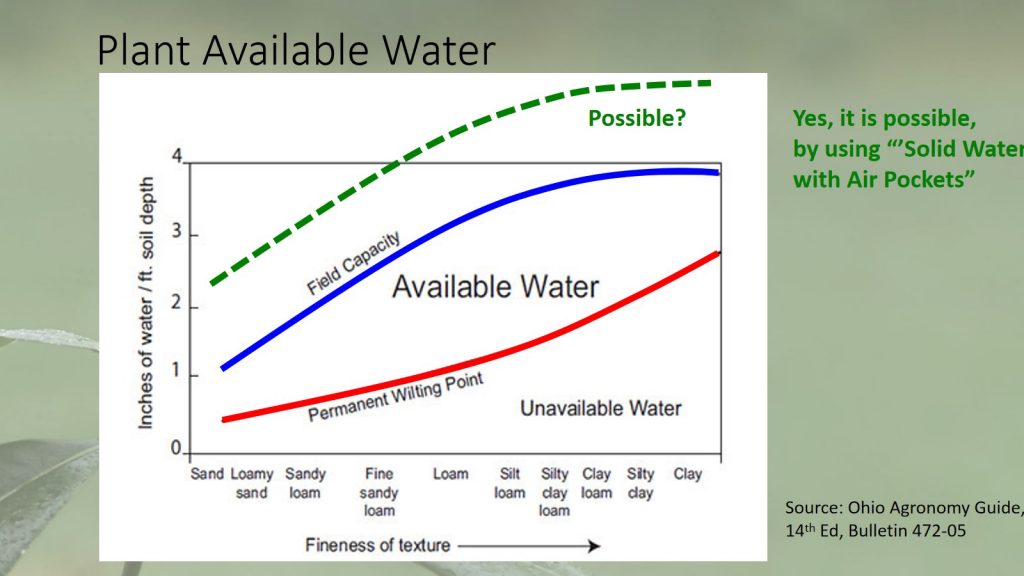
The real limitation is in the Plant Available Water (PAW), no matter how much you irrigate the soil or how much rainwater falls on to it. The often compacted soils after construction projects makes it worse. Conventionally, you can’t increase the Field Capacity (FC) without an expensive soil amendment, as it is defined by the texture of the soil. So irrigation professionals prescribe frequent watering to provide adequate and not excess water to plants.
This Webinar will review the key feature of a new irrigation technology: stabilizing soil moisture and significantly boosting the PAW without drowning the plant roots. In addition, we will also discuss the other factors that may not result in casualty, but greatly impacts the overall plant health and overall growth potential, e.g. mulching, road salt, girdling roots and soil compaction.
Learning Objectives:
- Learn the benefits and importance of trees and what they can do to your institution
- Study and learn common mistakes and causes of plant death in urban environment, especially newly planted trees.
- Learn new technologies that help to solve the problems with the use of natural resources